

Signs Childhood Trauma Is Affecting You as an Adult
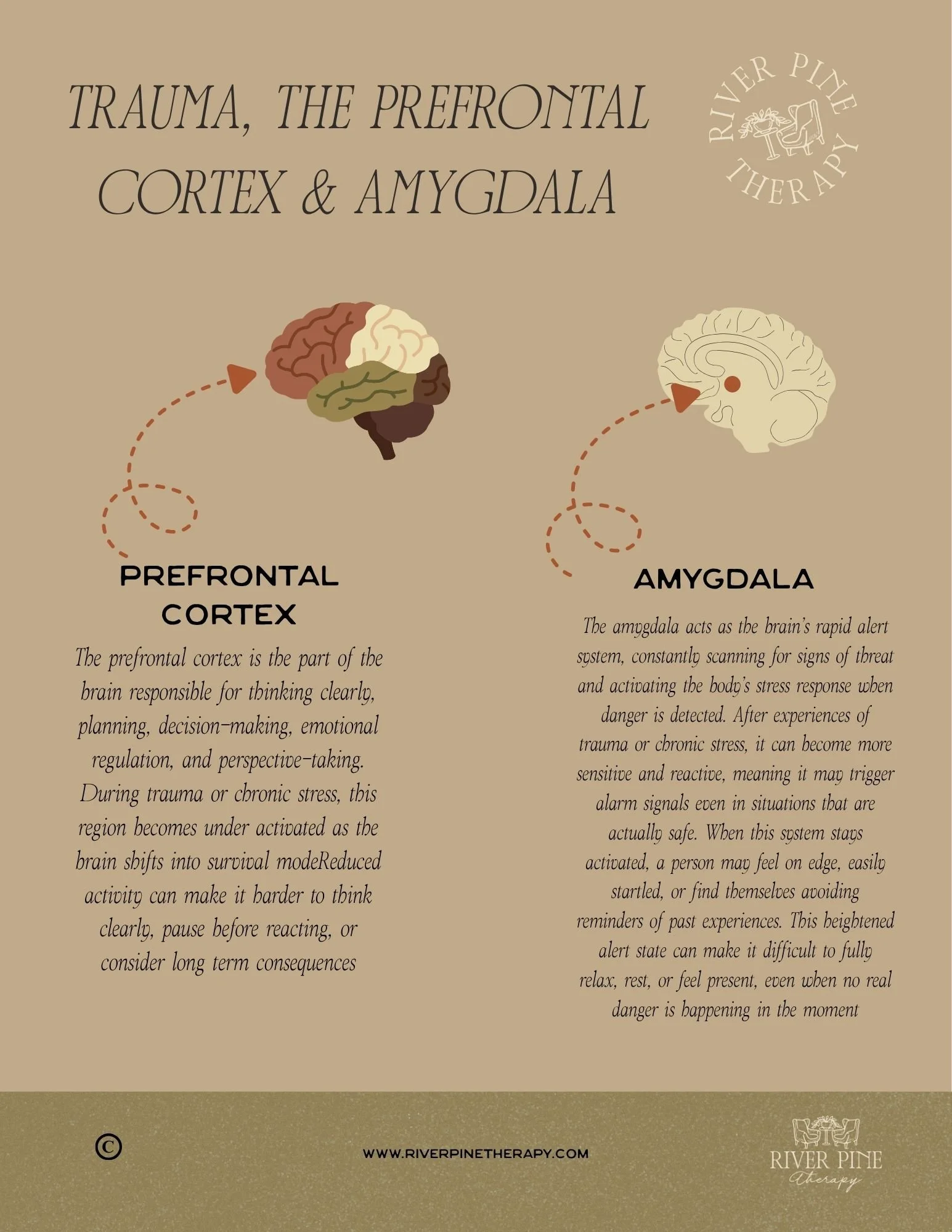
Before we continue, I'd like to pause on one word that we'll come back to throughout this article: safety.
The nervous system will also come up, we love her and her beauty in creating protection. Diving into what this actually is and why it is important will come later!
I've learned through countless conversations with clients that many people believe trauma only happens when someone's physical safety has been threatened. Because of that, they quickly dismiss their own experiences by saying things like, "But I wasn't abused," or "Nothing that bad happened to me."
The reality is that our nervous system experiences safety in more ways than one. While physical safety is essential, children also need emotional safety; a sense that they are loved, protected, comforted, and accepted, even when they make mistakes or experience big emotions. When those needs aren't consistently met, children adapt in ways that help them survive or even try to receive those basic emotional necessities. These early adaptations often follow us into adulthood.
My hope is that by expanding our understanding of safety, you'll approach this article with curiosity rather than comparison. This isn't about deciding whether your experiences were "bad enough." It's about understanding how your unique experiences may have shaped the way you move through the world today.
Okay… let’s dive in!
Have you ever wondered why you seem to carry the weight of the world on your shoulders? Maybe you've always been "the strong one", the person everyone depends on, the one “no one has to worry about”, but underneath it all, you're exhausted, disconnected, and looking for answers. Perhaps you've been told you're angry, overly sensitive, or too emotional, when in reality you're simply trying to navigate life with a nervous system that learned to survive long before it learned to feel safe.
Childhood trauma doesn't only refer to a single catastrophic event. It can also include ongoing experiences such as emotional neglect, chronic criticism, inconsistent caregiving, exposure to violence, or growing up in an environment where your emotional or physical needs were not consistently met. These experiences can shape how we see ourselves, relate to others, who we choose as partners, how we react to certain scenarios, and respond to stress well into adulthood.
Research reminds us that childhood adversity is far more common than many people realize. According to the Centers for Disease Control and Prevention (CDC), approximately 61% of adults report experiencing at least one Adverse Childhood Experience (ACE), and nearly one in six report experiencing four or more (Merrick et al., 2019).
Since the original ACE Study was published in 1998, our understanding of adversity has continued to grow. Expanded ACE frameworks recognize that children's well-being can also be affected by experiences such as emotional neglect, discrimination, community violence, bullying, housing or food insecurity, caregiver separation, and other chronic stressors that influence a child's sense of safety and belonging. Likewise, SAMHSA emphasizes that trauma is not defined solely by the event itself but by how an individual experiences it and the lasting effects it has on their physical, emotional, social, and psychological well-being.
Many of the behaviors we criticize in ourselves; people-pleasing, perfectionism, hyper-independence, emotional shutdown, or feeling constantly on edge, may have once been adaptive ways of coping, keeping the peace, or receiving love or connection. What helped you survive as a child may no longer be serving you as an adult.
The goal isn't to place blame on your past, but to help you better understand your experiences so you can move toward healing with greater self-compassion.
Let’s jump right in to the most common sings, but NOT the only ones.
1. You Feel Responsible for Everyone Else
Do you automatically take care of other people's emotions? Do you apologize even when nothing is your fault? Do you struggle to ask for help? Many adults who experienced childhood trauma learned early that staying safe meant keeping others happy, avoiding conflict, or becoming the responsible one. While these patterns may have helped you navigate childhood, they can become exhausting in adulthood.
2. You're Called "Angry" More Than You Feel Understood
Anger is often misunderstood. For many survivors of trauma, anger isn't the problem, it's information. Sometimes anger is saying:
"I don't feel safe."
"My boundaries have been crossed."
"I've carried too much for too long."
Women, especially, are often labeled as angry when they're expressing emotions that have been ignored for years.
3. Relaxing Feels Impossible
Even on vacation...Even after work...Even when nothing is wrong...
Your body stays alert. This isn't because you're "bad at relaxing."
Bruce Perry describes how chronic stress during childhood can shape the developing stress response system, making it difficult for the brain and body to recognize safety even years later (What Happened to You?, Perry & Winfrey, 2021).
4. You Feel Like You Have to Earn Love (most people don’t even recognize they are doing these things)
Maybe you believe or have underlying core beliefs like:
"I have to be useful."
"I can't make mistakes."
"If people really knew me, they'd leave."
These beliefs rarely appear overnight. They often develop over years of adapting to environments where love, attention, or safety felt inconsistent.
5. You're Always Waiting for Something Bad to Happen
Do you struggle to enjoy good moments because you're expecting them to end? Many trauma survivors describe feeling like they're constantly preparing for the next crisis..
It's often the nervous system trying to predict danger before it happens.
These Responses Once Helped You Survive, Connect, Meet a Need, Create Safety and MORE!
One of the most important things I want you to know is this: Your nervous system is not broken. It adapted.
Children cannot simply leave environments that don't feel safe. They depend on the adults around them for survival, so instead of escaping, they adapt. They become incredibly creative in finding ways to stay connected, avoid conflict, anticipate others' needs, or make themselves as "easy" as possible. These strategies are intelligent responses to the environments they grew up in.
The challenge is that our brains don't automatically recognize when the danger has passed.
Even as adults, when we have the ability to leave unhealthy relationships, set boundaries, or choose different environments, our nervous system may still respond as though the old rules apply. Your brain has a built-in survival network designed to keep you alive. This system is often called the threat detection system and it includes several parts of the brain that work together automatically and very quickly. One key part is the amygdala, which acts like an internal smoke detector. is designed to prioritize survival over comfort. If it spent years learning that the world was unpredictable or emotionally unsafe, it may continue scanning for signs of danger long after you're no longer in the environment that required those adaptations.
This can look like expecting conflict when none exists, feeling responsible for keeping everyone happy, struggling to trust people who have earned your trust, or finding it difficult to fully relax, even in moments of safety. These reactions aren't a sign that you're "too sensitive" or "stuck in the past." They're evidence that your nervous system learned its job well.
The good news is that our brains are capable of change throughout our lives. Through safe relationships, new experiences, and trauma-informed therapies such as EMDR, the nervous system can gradually learn to distinguish between past danger and present-day safety.
More about the amygdala and Trauma here: https://www.ptsduk.org/what-is-ptsd/the-science-and-biology-of-ptsd/
More on ACE’s here: https://www.samhsa.gov/sites/default/files/resourcefiles/sptac-ace-role-of-substance-misuse-prevention.pdf